GHK-Cu 100mg Vial: 7 Critical Safety Facts You Should Know
GHK-Cu 100mg Vial is a product label associated with GHK-Cu, also known as copper tripeptide-1, a copper-binding peptide studied for its potential role in skin biology, collagen-related processes, and tissue repair. Scientific interest in this compound comes from laboratory research and a limited number of human studies involving topical cosmetic formulations. However, evidence for a topical product does not establish the safety or effectiveness of an injectable product.
This guide to GHK-Cu 100mg Vial explains the compound’s scientific background, research findings, safety considerations, product-quality concerns, and regulatory status. It is intended for educational purposes and does not recommend injecting or otherwise using an unapproved peptide product.
What Is GHK-Cu 100mg Vial?
GHK-Cu is a complex involving the tripeptide glycyl-L-histidyl-L-lysine and copper. The compound has been investigated for biological activity associated with skin cells and extracellular-matrix processes. It is also used as an ingredient in some topical cosmetic products.
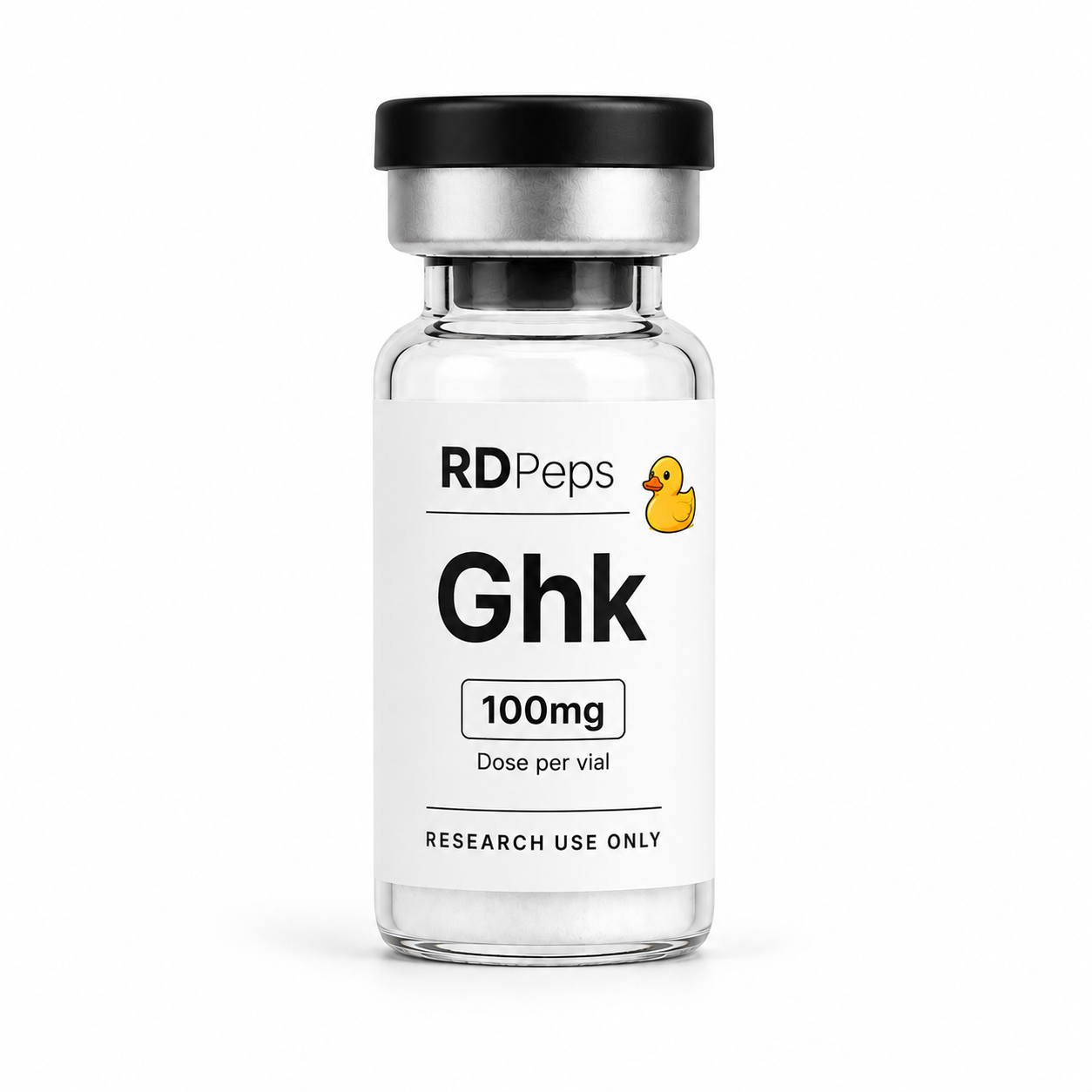
The term GHK-Cu 100mg Vial describes a labeled product presentation, not independent proof of its identity, purity, sterility, concentration, or suitability for human use. Products with similar names can differ in formulation, manufacturing standards, and intended route of administration.
A cosmetic ingredient and an injectable drug are not interchangeable. Each has different requirements for quality control, safety evaluation, and regulatory authorization.
How Does GHK-Cu Work?
Laboratory research suggests that GHK-Cu may influence cellular signaling associated with collagen, extracellular-matrix remodeling, and skin repair. Researchers have also explored its antioxidant and inflammation-related activity in experimental models.
These findings help explain why copper peptides are studied in skincare and tissue biology. Nevertheless, laboratory observations do not automatically translate into clinically meaningful results in humans. The biological effects of a compound can also depend on its formulation, stability, concentration, and route of exposure.
Research on topical GHK-Cu should therefore be interpreted separately from claims about injected products. Current evidence does not establish that an injectable vial produces the same effects as a cosmetic serum or cream.
Potential Research Applications
Researchers have explored GHK-Cu in several areas:
- Skin appearance: Investigations into skin texture, wrinkles, and other cosmetic outcomes associated with topical formulations.
- Collagen-related processes: Laboratory studies examining how the compound interacts with pathways involved in extracellular-matrix biology.
- Tissue-repair research: Experimental work investigating cellular responses associated with wound repair.
- Hair-related cosmetic research: Small studies have explored topical copper-peptide formulations and selected hair-related outcomes.
These areas remain subject to important evidence limitations. Small studies and laboratory findings do not establish broad therapeutic benefits, and results from one formulation cannot automatically be applied to another.
What Does Human Research Show?
Human evidence for GHK-Cu is limited and depends strongly on the formulation and route studied. Some small studies have examined topical cosmetic applications, but findings have not established that GHK-Cu is an effective treatment for every skin or hair concern marketed online.
A recent review of the evidence describes a small and heterogeneous clinical literature, including topical studies with limitations in size, formulation characterization, and outcome measurement. It also notes that topical findings do not establish the safety or effectiveness of injectable products. <Cite refs={[“turn645764search1″,”turn645764search3”]} />
For anyone researching GHK-Cu 100mg Vial, the distinction is important: evidence involving a topical cosmetic does not prove that a product labeled for injection has the same composition, biological effects, or safety profile.
Important Safety Considerations
The safety profile of a product depends on its formulation, route of administration, manufacturing quality, and available clinical evidence.
1. Limited injectable safety data: Human evidence supporting injectable GHK-Cu remains inadequate. Safety conclusions drawn from topical cosmetic use should not be extended to injection.
2. Immune reactions: Peptides and their impurities or aggregates may trigger unwanted immune responses. Regulatory reviews have highlighted potential immunogenicity concerns for injectable GHK-Cu products. <Cite refs={[“turn645764search12″,”turn645764search2”]} />
3. Purity and aggregation: The presence of impurities, degradation products, or peptide aggregates may affect product quality. A label or seller-provided description does not independently establish pharmaceutical quality.
4. Sterility and contamination: Products intended for injection require stringent manufacturing and testing controls. Contamination can cause serious harm.
5. Uncertain systemic effects: The effects of injectable GHK-Cu on the body, including its distribution and longer-term safety, are not adequately established in humans.
6. Unsupported claims: Statements promising rapid healing, dramatic hair growth, anti-aging effects, or whole-body regeneration should be treated cautiously unless supported by appropriate clinical evidence.
7. Medical assessment: Anyone experiencing severe symptoms after exposure to an injectable product should seek prompt medical care. A healthcare professional can assess possible complications and determine whether urgent treatment is needed.
Product Quality and Regulatory Status
A stated amount of 100mg does not independently verify what a vial contains. Reliable product assessment requires appropriate identification testing, batch-specific quality documentation, and manufacturing controls suited to the intended use.
In the United States, GHK-Cu used in topical cosmetics is subject to a different regulatory framework from an injectable drug. Cosmetic availability does not mean that the ingredient has been approved as an injectable medicine. Regulatory status can vary by country, so current information should be checked with the relevant medicines authority.
The FDA has identified potential safety concerns regarding compounded injectable GHK-Cu, including limited human safety information and possible immunogenicity related to peptide impurities or aggregation. <Cite refs={[“turn645764search12″,”turn645764search2”]} />
Readers should not assume that online availability, a certificate of analysis, or the words “research grade” prove that a product is authorized or safe for human use.
Frequently Asked Questions
What is GHK-Cu 100mg Vial?
It is a product label associated with a stated quantity of copper tripeptide. The label alone cannot confirm the contents, quality, sterility, or regulatory status of the product.
Is GHK-Cu proven to reverse aging?
No. Research into skin-related pathways and cosmetic outcomes does not establish that GHK-Cu reverses aging or provides broad anti-aging benefits.
Is injectable GHK-Cu the same as a copper-peptide serum?
No. A topical serum and an injectable product have different formulations, exposure routes, and safety requirements. Evidence for one does not establish the safety or effectiveness of the other.
Are the side effects fully known?
No. Human safety data for injectable GHK-Cu are insufficient to establish the full range of potential adverse effects or their frequency.
Does a 100mg label guarantee purity?
No. A label is not independent proof of identity, concentration, purity, or sterility.
Conclusion
GHK-Cu 100mg Vial is associated with interest in copper-peptide research, particularly in skin biology and cosmetic science. Some topical research is available, but the evidence remains limited and cannot establish the safety or effectiveness of an injectable product.
The most important considerations are route-specific evidence, manufacturing quality, possible immune reactions, and regulatory status. Claims should be evaluated critically, and decisions involving investigational or unapproved peptide products should be discussed with a qualified healthcare professional.